Conference Breakout Sessions
Additional programming you can book alongside the keynote or as a standalone workshop session.


Resilience Governance: Building the Framework Before the Crisis
Most organizations discover their resilience gaps during the crisis that exposes them. By then, the cost of the gap has already been paid. This session addresses resilience at the level where it actually gets decided: governance, before disruption arrives, not during it.
Participants work through the PACE framework (Primary, Alternate, Contingency, Emergency) as a governance tool rather than an abstract concept. You will learn to evaluate existing continuity plans against PACE structure, identify where a plan has only a Primary option and no real Alternate or Contingency behind it, and understand what leadership decisions have to be made in advance for PACE to function when the Primary path fails.
This session also covers the leadership judgment question that technical planning alone cannot answer: who decides, how fast, and on what authority, when the plan in front of them no longer applies. Governance structures that answer this question in advance produce organizations that act. Governance structures that leave it open produce organizations that wait for permission that may not arrive in time.
Best suited for: boards, executive leadership teams, risk management teams, and business owners and entrepreneurs who need to build governance and pre-crisis planning structure into their organizations.


Years ago, early in my international development work, I was walking a power line right-of-way near a village in Northern Luzon when the tree line broke into a clearing and revealed a small compound: three shacks with well-armed men standing inside it. Neither of us expected the other. For a moment, nobody moved. Then I waved, backed up slowly until I was out of their sightline, and took off running.
There was no protocol for that specific moment. But the team had alternate vehicle exit routes, a separation contingency, and emergency communication in place, built for the terrain and geography of the region, not for an armed encounter. None of it was designed with this threat in mind. All of it worked anyway. The whole team extracted from the area quickly, because the structure was already there before anyone knew it would be needed for this.
That is the argument this session makes about resilience: it does not have to be built for the exact threat that shows up. It has to be built well enough that it holds regardless of which threat shows up. The session breaks down how to build decision structures and team protocols that transfer across threat types, and why the correct real-time call in a moment like that rarely comes down to more training or a longer procedure.
Participants leave with a practical decision framework for the moment a plan fails: what to assess first, what to disregard, and how to act on incomplete information without waiting for certainty that will not arrive in time.
Best suited for: field teams, operations staff, small business owners, and mid-level leadership who need practical decision-making skills for the moment planning ends and improvisation begins.


Conflict De-escalation
De-escalation is not a scripted procedure. It depends on reading what is actually driving the escalation, whether that is a perceived threat, an unmet need, or a breakdown in communication, and adapting the response to match it. What changes between an office and a field setting is not the underlying skill. It is the conditions you are applying it under.
This training covers practical de-escalation skills: recognizing early warning signs, using verbal and nonverbal communication to reduce tension, and maintaining composure under pressure. You will learn to assess threat level, understand what is driving the behavior, and recognize when disengagement is the only safe response.
In an office setting, de-escalation happens in close quarters, often with coworkers present and organizational dynamics in play. Backup is usually nearby, but confined space and workplace relationships change how a situation has to be handled. In a field setting, backup is not immediate, the other party is often unfamiliar, and misreading the situation carries real consequences. The judgment stays the same. What you can rely on around you does not.
You will develop the communication and judgment skills to restore function in either setting without winning arguments or proving points.
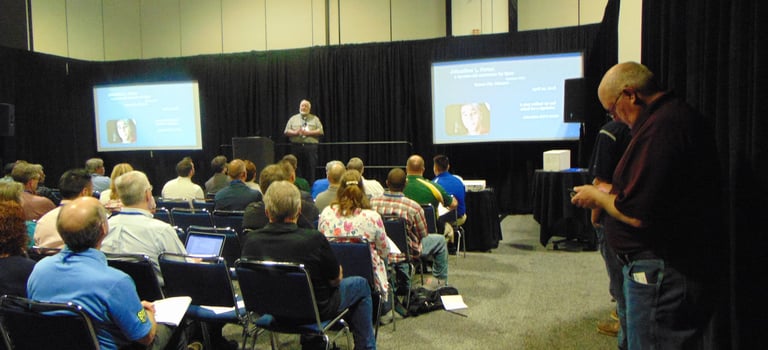
Situational and Threat Awareness
Threat awareness is the foundation of an effective security response. Without it, even advanced defensive techniques arrive too late. This training develops the cognitive skills to observe your environment actively, recognize when a threat is developing, and respond before the threat has fully committed.
You will learn to sustain situational awareness through the OODA Loop framework (Boyd's Observe-Orient-Decide-Act cycle) and recognize pre-attack indicators—the non-verbal cues and behavioral patterns that signal escalating threat. You will understand how threats select targets and conduct surveillance, the progression known as the Cycle of Violence, and how early recognition breaks that cycle. The training includes environmental scanning techniques: how to segment your surroundings, use natural cover and concealment strategically, and maintain awareness without the paralysis of constant hypervigilance.
For infrastructure and utility operations, this training is tailored to the specific threat environment: recognizing surveillance of critical assets, identifying behavioral anomalies in right-of-way access, and maintaining operational awareness in distributed, open environments where conventional security measures are not feasible. The framework remains the same. The threat categories and environmental factors shift to match your operational reality.
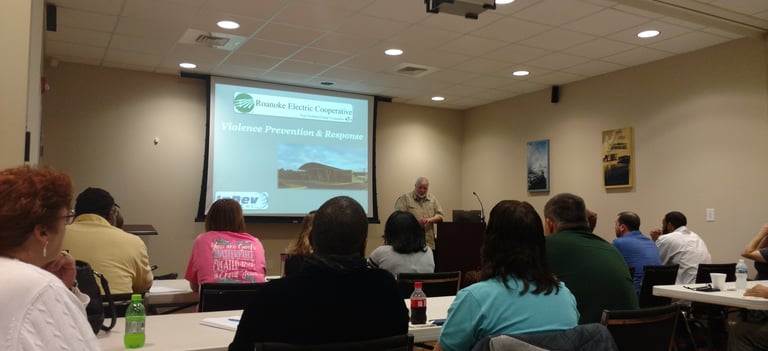
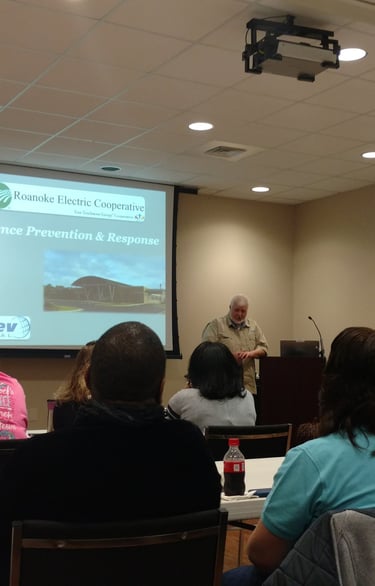
Best suited for: utility and infrastructure field personnel, security staff, and any team responsible for recognizing threats before they fully develop.
Workplace violence takes different forms in different environments. Field professionals work alone or in small crews without immediate backup, interacting with unfamiliar landowners and the public in unpredictable situations. Office environments present different threats: confined spaces, proximity to coworkers, and escalations that unfold within organizational structures. Both require a security-aware prevention program, not just individual awareness.
This training develops threat recognition at the organizational level: establishing behavioral baselines, identifying anomalies, and building the reporting structure that gets a concern to the right person before it escalates. You will develop incident documentation practices that protect both individual employees and the organization, and understand how a workplace violence prevention program should be structured to function before an incident, not just respond after one.
This training operates within a broader security context. While the primary focus is prevention program structure and organizational response, you will also understand how critical incidents—including active shooter events—fit into the threat environment, and how a resilient prevention program prepares an organization across that full spectrum.
Workplace Security and Violence Prevention


Best suited for: HR and safety professionals, organizational leadership, and any team responsible for building or maintaining a workplace violence prevention program.